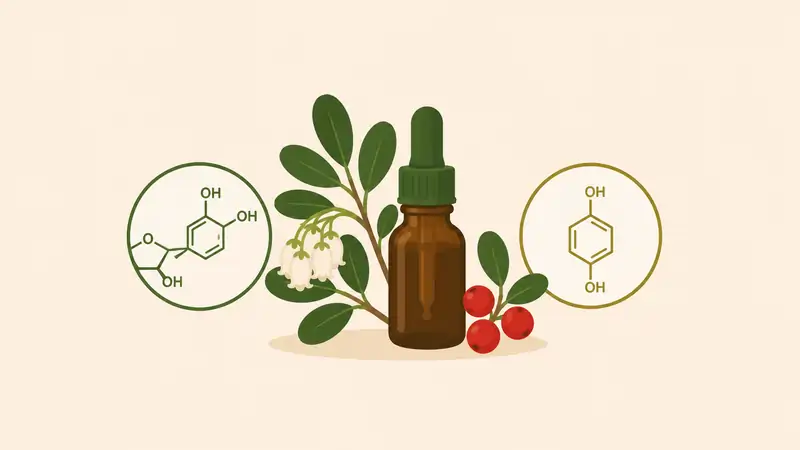
Arbutin vs Hydroquinone in Uva Ursi is a chemistry and labeling question. Bearberry leaves naturally contain arbutin, a plant glycoside. After ingestion, the body can process arbutin into hydroquinone-related metabolites. That does not mean an uva ursi tincture automatically contains added hydroquinone as a separate finished ingredient.
The confusion begins when scientific articles discuss metabolism while product pages discuss the original botanical constituent. Secrets Of The Tribe distinguishes what is present in the leaf, what appears on the ingredient label, and what the body may form after consumption.
This article explains the difference between arbutin, free hydroquinone, hydroquinone conjugates, and topical hydroquinone products. It also shows what an uva ursi label can and cannot prove.
What is the difference between arbutin and hydroquinone?
Arbutin and hydroquinone are related compounds, but they are not identical.
Arbutin is a glycoside. Its molecule combines a hydroquinone-related portion with a glucose unit. Hydroquinone is a smaller compound without that attached sugar.
The glucose bond changes the molecule’s size, solubility, absorption, metabolism, and biological behavior. For this reason, the two names cannot be exchanged casually on a supplement label.
| Feature | Arbutin | Hydroquinone |
|---|---|---|
| Chemical category | Phenolic glycoside | Phenolic compound |
| Glucose attached | Yes | No |
| Naturally associated with bearberry leaves | Yes | Discussed mainly through metabolism and trace chemistry |
| Typical supplement-label wording | May appear as a constituent or standardization marker | Should not be assumed unless specifically declared |
| Also used in topical product discussions | Yes, especially cosmetic arbutin | Yes, as a separate skin-lightening drug ingredient |
| Interchangeable term | No | No |
What does uva ursi naturally contain?
Uva ursi products generally use the leaves of Arctostaphylos uva-ursi, also called bearberry. The leaves contain several groups of plant compounds.
Commonly discussed constituents include:
- Arbutin and related hydroquinone glycosides.
- Tannins.
- Flavonoids.
- Phenolic acids.
- Triterpenes.
- Other naturally occurring plant compounds.
Arbutin is often used as a marker because it is one of the best-known bearberry leaf constituents. However, the leaf is a complex botanical material rather than purified arbutin.
A tincture also reflects its extraction system. Alcohol, water, glycerin, extract ratio, plant quality, and processing conditions affect which compounds enter the finished liquid.
Arbutin content is not universal
Different bearberry preparations may contain different arbutin levels. Variation can result from species confirmation, harvest timing, growing conditions, leaf age, drying, storage, extraction, and manufacturing controls.
A label that states only “uva ursi tincture” does not reveal an exact arbutin amount. A measured percentage or amount requires analytical testing and a clear declaration.
Does uva ursi tincture contain hydroquinone?
An uva ursi tincture should not be described as a hydroquinone product unless hydroquinone has been measured and specifically declared in the finished formula.
The more accurate statement is that bearberry leaves contain arbutin, which is chemically related to hydroquinone and can be metabolized into hydroquinone-related compounds after ingestion.
These statements are not equivalent:
- “The leaf contains arbutin.”
- “Arbutin can form hydroquinone-related metabolites.”
- “The tincture contains added hydroquinone.”
The first two may describe botanical chemistry and metabolism. The third is a finished-product ingredient claim and requires separate evidence.
Trace amounts of free hydroquinone may be discussed in analytical or safety assessments of botanical preparations. That does not turn the entire product into purified hydroquinone or a topical hydroquinone medication.
Why do scientific sources mention hydroquinone?
Scientific sources mention hydroquinone because researchers study what happens after arbutin enters the body.
Arbutin may be absorbed and processed through enzymatic and metabolic pathways. Scientific assessments describe conversion into hydroquinone-related compounds, followed by conjugation into forms such as hydroquinone glucuronide and hydroquinone sulfate.
Conjugation attaches another chemical group to the molecule. This process changes how the compound circulates and is excreted.
A simplified sequence is:
- Bearberry leaf provides arbutin.
- Arbutin is absorbed and metabolized.
- Hydroquinone-related intermediates may form.
- The body creates glucuronide and sulfate conjugates.
- These metabolites may be excreted in urine.
This is a metabolic description. It is not an ingredient list.
Metabolites are not automatically labeled ingredients
A metabolite is formed after the body processes a consumed substance. Manufacturers normally list what is present in the product before ingestion, not every compound the body may later produce.
For example, a label may declare arbutin-containing bearberry leaf extract. It would not normally list hydroquinone glucuronide as an ingredient because that conjugate forms through metabolism rather than being added to the bottle.
Is hydroquinone in cosmetics the same issue?
No. Topical hydroquinone products belong to a separate product and regulatory context.
Hydroquinone has been used as an active ingredient in skin-lightening products. In that context, hydroquinone itself is placed directly into a topical formula at a declared concentration.
An oral bearberry leaf tincture is different:
- It contains a botanical extract rather than a topical drug formula.
- Its best-known natural marker is arbutin.
- Hydroquinone enters the discussion mainly through chemistry and metabolism.
- The route of exposure is different.
- The formulation and regulatory category are different.
A cosmetic article about topical hydroquinone should not be used to describe the finished composition of an oral uva ursi tincture.
| Context | What the term means | Common mistake |
|---|---|---|
| Bearberry leaf chemistry | Arbutin is a natural glycoside in the leaf | Calling arbutin purified hydroquinone |
| Human metabolism | Hydroquinone-related metabolites and conjugates may form | Listing metabolites as bottle ingredients |
| Topical skin products | Hydroquinone may be a directly added active drug ingredient | Assuming the same product category applies to tincture |
| Supplement standardization | Arbutin may be measured as a marker | Assuming standardization means added hydroquinone |
Does the word hydroquinone mean the tincture is synthetic?
No. A scientific discussion of hydroquinone-related metabolism does not prove that a tincture contains a synthetic added ingredient.
The relationship begins with a naturally occurring glycoside in the plant. Chemical names may sound industrial because science uses the same naming system for compounds regardless of whether they originate in a plant, laboratory, cosmetic, or metabolic pathway.
However, natural origin does not settle every safety question. Dose, concentration, duration, route, metabolism, individual health factors, and product quality still matter.
The editorial standard at Secrets Of The Tribe is to avoid both extremes. Arbutin should not be presented as identical to hydroquinone, but hydroquinone-related metabolism should not be hidden when explaining uva ursi chemistry.
Does arbutin percentage equal hydroquinone percentage?
No. An arbutin percentage does not equal the same percentage of free hydroquinone.
Arbutin has a larger molecular structure because it includes glucose. Its measured weight includes the complete glycoside, not only the hydroquinone-related portion.
The body also does not convert every measured milligram into an equal amount of free hydroquinone at one location or one time. Absorption, hydrolysis, conjugation, distribution, and excretion affect the result.
Therefore, a product standardized to a stated arbutin level cannot be relabeled as containing the same percentage of hydroquinone.
Standardized does not mean purified
Standardization usually means that a preparation meets a specified level or range for a marker compound. The product may still contain many other botanical constituents.
A standardized bearberry extract is not necessarily isolated arbutin. It is also not automatically a purified hydroquinone formula.
Can a dropper amount reveal the arbutin level?
No. A dropper volume only states how much liquid is measured.
To estimate or compare arbutin exposure, the label or specification would need more information, such as:
- Arbutin amount per serving.
- Standardized arbutin percentage.
- Extract weight per serving.
- Botanical equivalent.
- Extract ratio.
- Lot-specific analytical results.
Even an extract ratio does not independently provide the arbutin level. It describes the relationship between starting plant material and extract, not the measured concentration of every constituent.
Arbutin and Hydroquinone Label Checklist
Use this checklist when an uva ursi product page mentions arbutin, hydroquinone, bearberry leaf, or standardization. It helps separate the declared ingredient from metabolites and unrelated topical products.
Confirm the botanical identity
Look for Arctostaphylos uva-ursi. The common name bearberry alone is less precise.
Check the plant part
Confirm that the formula uses leaf. Fruit, stem, and whole-plant materials should not be assumed equivalent.
Identify the declared ingredient
Determine whether the label lists leaf powder, tincture, dry extract, arbutin-standardized extract, or another preparation.
Separate constituent from metabolite
Arbutin is a plant constituent. Hydroquinone conjugates may form after metabolism and are not automatically bottle ingredients.
Look for measured amounts
Do not infer arbutin concentration from dropper size, extract ratio, bitterness, color, or smell.
Check whether hydroquinone is explicitly declared
If hydroquinone appears as a claimed finished-product ingredient, the manufacturer should provide clear labeling and analytical support.
Separate oral and topical products
Do not use information about skin-lightening creams to interpret an oral bearberry leaf tincture.
Review duration and warnings
Uva ursi products are not suitable for unrestricted long-term self-use. Follow the actual label and relevant professional guidance.
Treat unclear wording as unknown
When a product page switches between arbutin and hydroquinone without explaining the difference, request clarification rather than assuming equivalence.
Why does this distinction matter for safety?
Using the wrong term can distort both risk and product identity.
Calling arbutin “hydroquinone” may make a botanical tincture sound like a topical drug product. Ignoring hydroquinone-related metabolism can create the opposite problem by making the chemistry sound simpler than it is.
Safety assessment should consider:
- The exact bearberry preparation.
- Arbutin content when known.
- Serving amount.
- Duration of use.
- Kidney and liver health.
- Pregnancy or breastfeeding.
- Age.
- Medication use.
- The reason for urinary symptoms.
European assessment documents describe bearberry leaf preparations as limited to short-term use under defined conditions. That does not support continuous or repeated unsupervised use.
Urinary symptoms can have several causes. Fever, chills, blood in urine, side or back pain, vomiting, pregnancy, severe symptoms, or persistent discomfort require medical assessment.
Can hydroquinone metabolism prove that uva ursi will work?
No. A plausible metabolic pathway does not by itself prove a meaningful result from a specific commercial product.
Product performance may depend on:
- Botanical identity.
- Leaf quality.
- Arbutin concentration.
- Extraction method.
- Serving amount.
- Absorption and metabolism.
- The cause and severity of symptoms.
- Individual health factors.
Mechanistic research can explain why scientists study a compound. It cannot replace controlled human evidence or medical evaluation.
FAQ
Is arbutin the same as hydroquinone?
No. Arbutin is a glycoside containing a glucose unit attached to a hydroquinone-related structure.
Does uva ursi naturally contain arbutin?
Yes. Arbutin is one of the best-known natural constituents of Arctostaphylos uva-ursi leaves.
Does uva ursi tincture contain added hydroquinone?
Not unless hydroquinone is specifically declared and verified as a finished-product ingredient.
Why do scientific articles mention hydroquinone?
They discuss how the body can metabolize arbutin into hydroquinone-related intermediates and conjugated metabolites.
Are hydroquinone metabolites ingredients in the bottle?
No. Metabolites form after the body processes the consumed compounds.
Is cosmetic hydroquinone the same as bearberry tincture?
No. Topical hydroquinone is a separate active drug ingredient used in skin products, while bearberry tincture is a botanical extract.
Does an arbutin percentage equal a hydroquinone percentage?
No. The molecules have different weights, and human metabolism does not create a simple one-to-one finished-product conversion.
Can dropper size show how much arbutin is present?
No. Dropper size shows liquid volume. Arbutin content requires a declared amount or analytical measurement.
Glossary
Arbutin – A naturally occurring phenolic glycoside found in bearberry leaves.
Arctostaphylos uva-ursi – The accepted botanical name of uva ursi or bearberry.
Conjugate – A metabolite formed when the body attaches another chemical group to a compound.
Free hydroquinone – Hydroquinone that is not attached to glucose, glucuronic acid, sulfate, or another group.
Glucuronide – A conjugated metabolite produced when the body attaches glucuronic acid to a compound.
Glycoside – A molecule containing a sugar attached to a non-sugar component.
Hydroquinone – A phenolic compound related structurally to the non-sugar portion of arbutin.
Metabolite – A substance formed when the body processes another compound.
Standardization – Manufacturing control that targets a specified level or range of a marker compound.
Sulfate conjugate – A metabolite formed when the body attaches a sulfate group to a compound.
Conclusion
Bearberry leaves naturally contain arbutin, while hydroquinone enters the discussion mainly through chemical structure and metabolism. The two terms are related but not interchangeable, and hydroquinone should not be treated as a separate tincture ingredient unless the finished product actually declares and verifies it.
Sources Used
European scientific assessment of bearberry leaf chemistry, arbutin metabolism, hydroquinone conjugates, safety, and short-term use, Assessment Report on Arctostaphylos uva-ursi Folium – ema.europa.eu/en/documents/herbal-report/final-assessment-report-arctostaphylos-uva-ursi-l-spreng-folium-revision-2_en.pdf
European regulatory overview and herbal monograph documents for bearberry leaf preparations, Uvae ursi folium – ema.europa.eu/en/medicines/herbal/uvae-ursi-folium
Chemical identity, molecular formula, synonyms, and description of arbutin as a hydroquinone glucoside, Arbutin Compound Record – pubchem.ncbi.nlm.nih.gov/compound/Arbutin
Scientific risk assessment describing absorption of arbutin and formation of hydroquinone conjugates, Risk Assessment of Free Hydroquinone Derived from Uva-ursi Folium – pubmed.ncbi.nlm.nih.gov/24296864
FDA regulatory explanation of hydroquinone as an active ingredient in unapproved over-the-counter skin-lightening drug products, OTC Skin Lightening Products – fda.gov/drugs/drug-safety-communications/fda-works-protect-consumers-potentially-harmful-otc-skin-lightening-products
FDA consumer information on the separate safety and regulatory context of topical hydroquinone skin products, Skin Product Safety – fda.gov/consumers/skin-facts-what-you-need-know-about-skin-lightening-products/skin-product-safety